America 250: The Geometry of a Firework
A firework is a polar equation that burns for about two seconds. Velocity throws sparks outward in straight lines, gravity bends every line into the same parabola, and the eye reads the whole family of curves as a bloom. On July 4, 2026, the United States turns 250, and the sky over every town in the country will run that equation on repeat all night.
Anniversaries this size get a word you will never otherwise use: semiquincentennial. It gets one outing every 250 years, so the occasion seemed to deserve more than a stock photo. Understory, the house artist, drew the geometry underneath the celebration instead: the burst, the star grid, the cracked bell, the wing, the sunburst seal. No flags, no slogans, no text. Just the shapes everyone already knows by silhouette.
The shapes of the two-fifty
Firework Burst
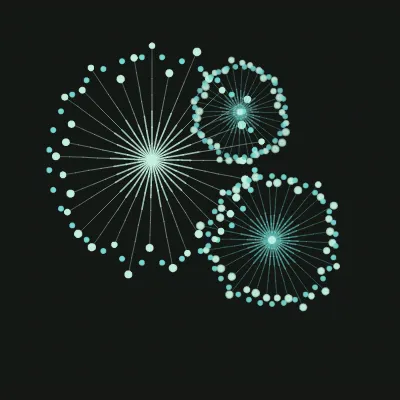
The signature shape of the holiday is a point-cloud with physics. Sparks leave the shell at equal speed, so at any instant they lie on a sphere; drag and gravity then peel the sphere into trailing arcs. The drawing layers several bursts at different scales, each with velocity fall-off in the spark spacing, which is exactly why a real burst looks like it breathes.
Star Field
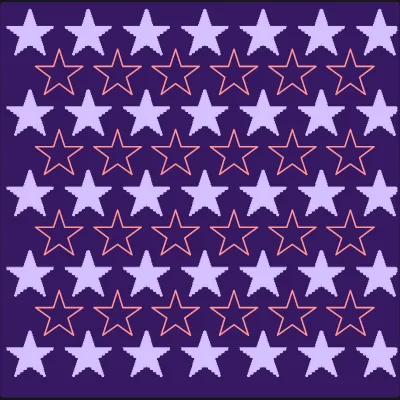
The five-pointed star has been the country's favorite repeating unit since 1777, and it tessellates beautifully: offset rows lock together so the negative space between stars becomes its own pattern. Alternating filled and outlined rows let the grid flicker between figure and ground, the way a flag ripples between cloth and symbol.
Liberty Bell Crack
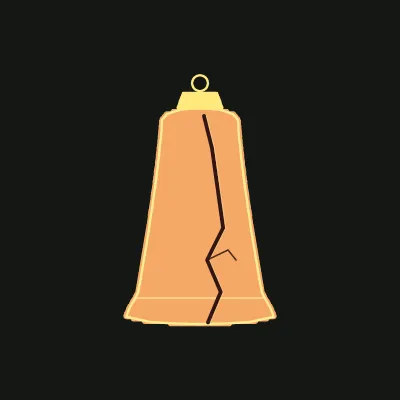
The most famous bell in America is famous for being broken. The silhouette alone is just a bell; the single diagonal line rising from lip to crown is what makes it THE bell. The drawing treats the crack as the subject and the bell as its frame, which is more or less how history has treated it too.
Eagle Pinion
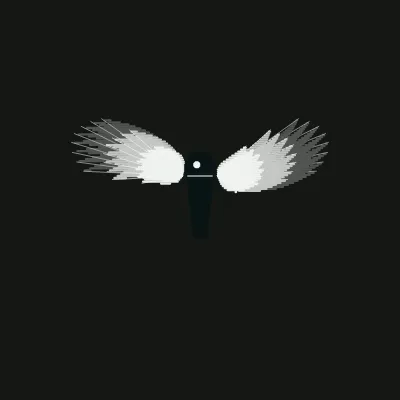
A spread wing is a fan of arcs sharing one hinge. Primary feathers radiate from the shoulder in overlapping layers, each arc slightly longer than the last, and the whole structure reads as flight before you have consciously seen a bird. No head, no talons, no heraldry. The geometry of lift is patriotic enough.
Colonial Seal
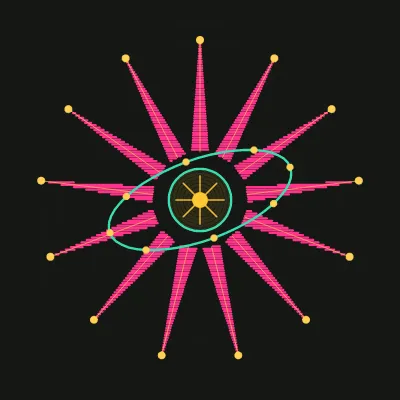
Thirteen rays from a common center, an orbiting ellipse, a small impression at the heart: the visual grammar of every early American seal and coin. Thirteen is an awkward number to divide a circle by, which is rather the point. The colonies made it work anyway.
The hero scenes
Fireworks Grand Finale
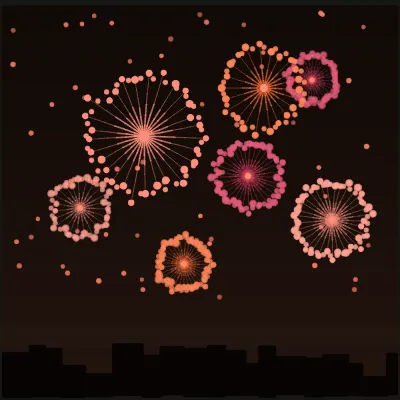
The finale is the moment the sky runs out of patience: many bursts at once, stacked at different depths, the biggest bloom pulled off-center the way a crowd actually sees it. Deep cobalt holds the field together while the bursts argue over it.
Bell and Horizon
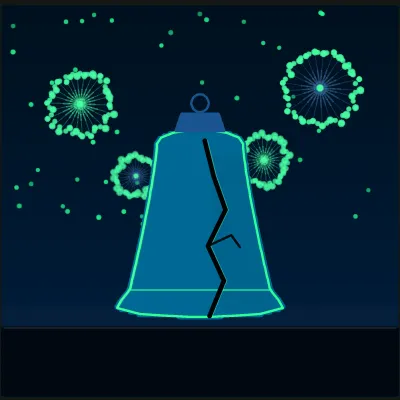
The quiet counterpart: the bell in silhouette against a horizon lit by someone else's fireworks. The crack reads clearly against the glow, 250 years old and still the first thing you look for.
Draw the two-fifty
None of these are flat pictures. Each is a living composition you can pull apart in the editor: branch a burst and recolor its sparks, hang the star grid behind your own drawing, or give the bell a different sky. Every remix keeps its credit trail back to the piece it grew from. Browse the drop in the America 250 gallery view, or start from a blank sky in the drawing editor. The two-fifty only comes around once; the geometry is reusable forever.