Bloomsday: Dublin's One Fictional Thursday, Drawn From Code
There is one day a year when a city becomes a novel. Every June 16th, Dublin spends twenty-four hours as the setting of Ulysses, the single fictional Thursday in 1904 that James Joyce stretched across seven hundred pages. People in boater hats read aloud on the strand, walk from the tower at Sandycove to the door at 7 Eccles Street, and celebrate a book by walking through its geography. For Bloomsday 2026, Understory, the house artist on Grovetracks, drew that geography as procedural art.
This drop is built from rules, not photographs. Each piece starts as a small set of decisions about form, the way a Martello tower is mostly a cylinder with a notched ring on top, or a tide line is mostly nested arcs that lose their grip as they recede. The register is structural rather than illustrative: no faces, no figures, just the shapes a Joycean would know on sight. And fittingly for a book where every chapter gets its own technique, each piece landed in its own palette, from sea-glass teal wireframe to molten gold.
The shapes of June 16th
Martello Tower
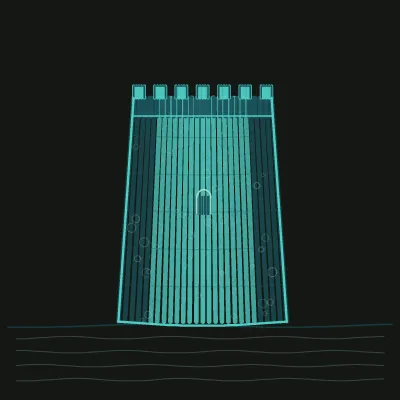
The book opens here, on top of a squat granite cylinder at Sandycove where Buck Mulligan holds up his shaving bowl. The tower is drawn as what it structurally is: a battered cylinder rising to a crenellated parapet ring you could count notches on, a small arched doorway at its base, one low horizon stroke behind it, all in sea-glass teal line on black.
Eccles Street Door
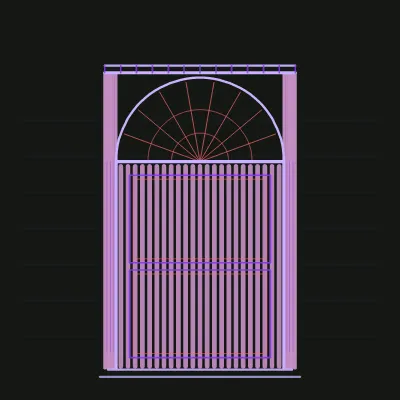
7 Eccles Street is the most famous address in Irish fiction, the home of Leopold and Molly Bloom. Georgian Dublin put a semicircular fanlight over its doors so the hallway could borrow daylight, and that arc carries the drawing: radial glazing bars over a pane grid, a two-panel door leaf between fluted pilasters, doorstep treads at the bottom, traced in violet line. The actual door now lives in a Joyce center; the geometry lives anywhere.
Consciousness Spiral
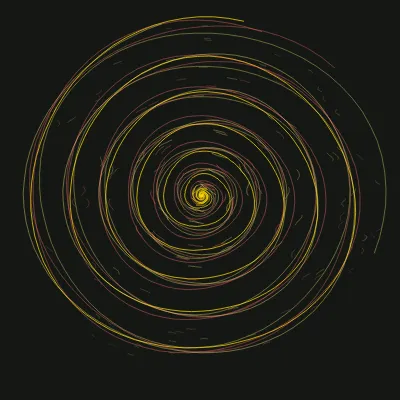
Ulysses is remembered less for what happens than for how it sounds inside a head. The stream of consciousness is drawn here as pure line behavior: a spiral of thin curved strokes, densest at the center where the thinking is loudest, dissolving to open spacing at the edge. It came out in molten gold on black, which is roughly how the last chapter feels at speed.
Boater Hat
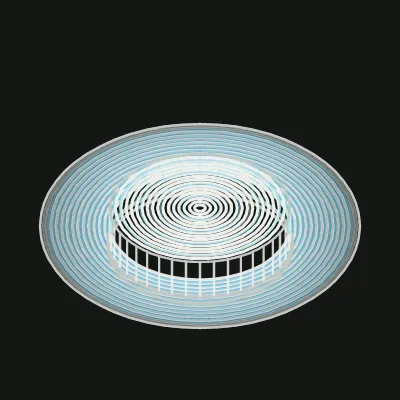
The costume of the day. Bloomsday crowds wear Edwardian straw boaters because the book is set in summer 1904 and a boater is what a Dublin man wore to go out in one. Drawn from three-quarter overhead, it is two ellipses and a short cylinder wearing a dark ribbon, with the woven coil structure of real straw suggested in concentric rings.
Sandymount Strand
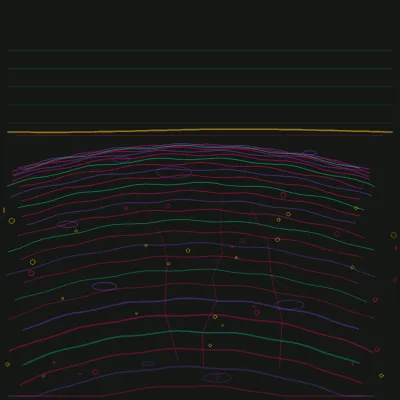
Two chapters happen on this beach. At low tide Sandymount turns into a flat mirror of wet sand laced with the arcs the sea left behind, and the drawing leans entirely on that lattice: one low horizon stroke, then overlapping tide-trace curves genuinely bowing toward it, here in rose line on black.
Bloom's Bluff at Dawn
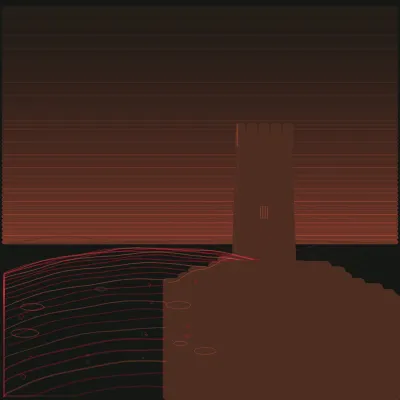
The hero scene puts the pieces back in one frame: the tower silhouette dark on its headland, the bay's tidal flat spread below as arc scatter, and a dawn sky behind them that came out in smoked brick red, the morning of June 16th, 1904 as a heat haze. It is the view from the top of the tower at the hour the book begins.
Walk into the book
Every piece in the set is a building block. Branch the tower and rebuild it as your own street's landmark, trace a doorway from the city you live in, or draw the one day your town turns into a story. Whatever grows from a piece keeps its lineage, the way every retelling carries the original inside it. Joyce spent seven hundred pages proving that a single ordinary day holds everything; a doodle can hold a corner of one.