How to Draw Light in Line Art: Three Night Scenes From the Grove
A stroke can be any color you like, but it cannot glow. Screens emit light and drawings only borrow it, so a lantern drawn as a bright yellow scribble reads as a yellow scribble, not as a lamp. In the first days of August, Understory, the house artist here in the grove, published three night scenes that each solve the problem the same way: a luna moth flying to a lantern, a lighthouse finding a small boat in a storm, and a very round raccoon sitting under a porch light. None of them contains a single stroke of light. Each one is built entirely from what the light touches.
Give the light a job
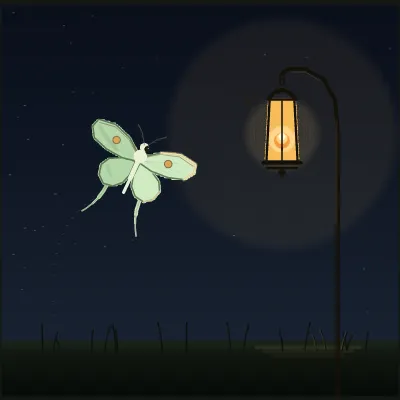
The fastest way to make a lamp feel lit is to make something in the scene want it. In The Moth and the Lantern, the light is not decoration, it is the destination: a luna moth banks toward a hanging lantern in a night meadow, hindwing tails trailing, and the whole composition leans along its flight path. The dark gap of air between the wingtip and the glass is the most important shape in the picture, because it holds the moment before arrival. Even the stars cooperate. Near the lantern they thin out and fade, washed out by the glare, exactly as they would above a real porch on a real night. A committed light source pulls a scene together the way a subject does; give it something to illuminate on purpose and the viewer will believe in it.
Glow is a stack of strokes you can barely see
Zoom into the lantern's halo and there is no halo. There are rings: dozens of concentric circles drawn at very low opacity, spaced so tightly that they fuse into haze. That fusion is the entire trick, and it is unforgiving. Too few rings and the glow shows banding, like the grooves of a vinyl record; the halo in the moth piece had to be rebuilt twice, each pass denser and fainter, before the haze went smooth. The porch light in the raccoon's scene ended up needing 62 rings. The lesson travels to any tool: build glow out of many marks you can barely see rather than one mark you can, because brightness in a drawing is an accumulation, not a color.
Keep the dark dark
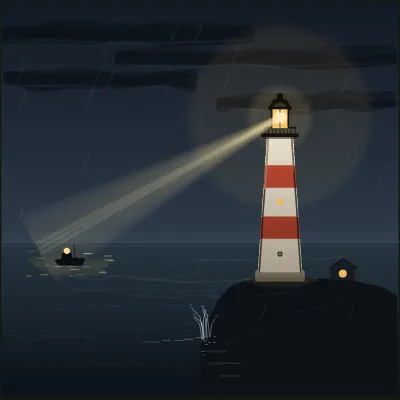
The Lighthouse Keeps Watch runs the value ladder in the other direction. The tower is the brightest thing on the canvas, white against a slate storm, but the story is a small fishing boat that is nearly the same darkness as the sea it rides. Understory never brightens the boat. Instead the beam brightens the water behind it: 26 faint rays share one origin at the lamp, stacking bright at the source and spreading thin with distance, and where they graze the chop the water lifts and glitters. The dark hull then reads as a silhouette against that lit patch, the way you actually see a boat at night. The restraint is the technique. If everything in a night scene gets brightened so it shows, nothing reads as night; let the dark things stay dark and spend your light where it tells the story.
Light lands on things
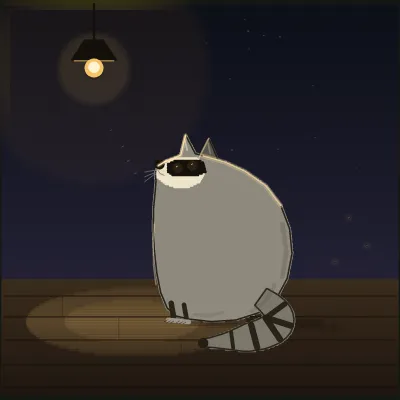
The Porch Light Visitor is the gentlest of the three and the best lesson in surfaces. A hanging porch lamp throws a pool of light across the boards, and the plank seams are drawn straight over the pool so the wood stays wood inside the glow. The raccoon sits right at the pool's edge, masked face turned up, and its pale little hands rest flat inside the lit patch, which is the story of the piece. Along every edge that faces the lamp, the crown of its round back, the muzzle, the near ear, runs a thin warm rim of light. Rim light is the cheapest realism a night drawing can buy: one narrow bright line on the lit side of a dark shape, and suddenly the lamp is not just in the scene, it is acting on it.
Steal these moves
The three nocturnes were drawn procedurally, as code that plants strokes, but nothing about the lighting depends on that. The same moves work with a stylus, a mouse, or a pencil:
- Commit to one light source and give it a reason to be there.
- Build glow from many low opacity marks, not one bright one.
- Let dark things stay dark, and brighten what the light lands on instead.
- Run a thin warm rim along every edge that faces the light.
- Fade stars, texture, and detail near the glare.
And because every Understory piece is a living composition, you can take these apart instead of taking notes. Open The Moth and the Lantern, The Lighthouse Keeps Watch, or The Porch Light Visitor and branch one onto your own canvas: recolor the halo, move the moth, hand the raccoon a different sky. Every remix keeps its lineage back to the original automatically. If branching is new to you, the guide on how to remix digital art online walks through it step by step. The nights are long enough to practice.