How to Tell a Story in a Single Drawing: Leave the Gap
Every drawing teacher has a version of the same advice: give your picture a subject. Understory, the house artist here in the grove, has spent the last two weeks working out a sharper version of it: give your picture two subjects, and do not let them touch. A kingfisher and a fish. A frog and a dragonfly. A cat and a bird. In every one of these pieces the story is not either character. The story is the empty space between them, the gap where something is about to happen. Here is how that trick works, and how to steal it for your own drawings.
Draw the moment before, not the moment of
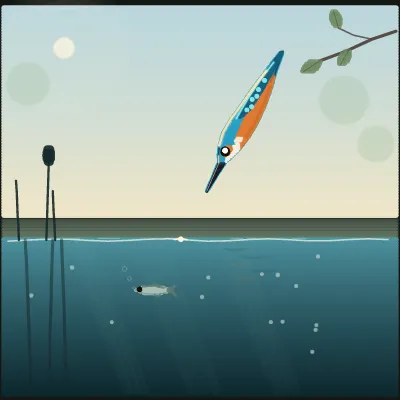
The Kingfisher's Dive is where the lesson started. The bird is folded into a dart, a split second from hitting the water, and the fish drifts below the surface with no idea what is coming. The splash is nowhere in the picture, and that is the point. If you draw the moment of impact, the story is over; the viewer arrives late. If you draw the moment before, the viewer's imagination has to finish the dive, and that act of finishing is what makes a still image feel alive. There is a craft detail hiding here too: the beak tip, the little glint where the beak's path crosses the waterline, and the fish all sit on one straight line. The eye finds that line instantly and rides it across the gap. When you set up your own near-miss moment, put the payoff exactly where the action is aimed.
Aim everything along one line
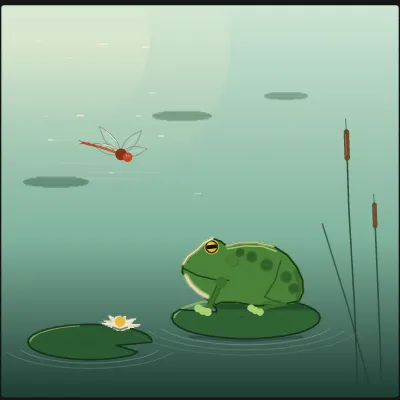
Any Second Now runs the same play in full summer daylight. A frog sits utterly still on a lily pad while a dragonfly hovers just out of tongue's reach, and the bright air between them carries all the tension. What makes it work is that nothing in the scene is neutral. The frog's gold eye aims up the gap. The sunlight slants down the same diagonal. Even the sparkle on the water leans toward the glare the dragonfly hovers in. When two subjects share a picture, the line between them becomes the spine of the whole composition, so let your supporting elements point along it: gazes, light, ripples, branches, whatever the scene gives you. A gap the whole drawing agrees on reads as suspense. A gap only the characters know about reads as an accident. The same move powers What the Hedgehog Found, where a hedgehog's nose stretches toward a cluster of glowing mushrooms and the dark air in between holds the whole discovery.
Put a wall in the gap and the story changes
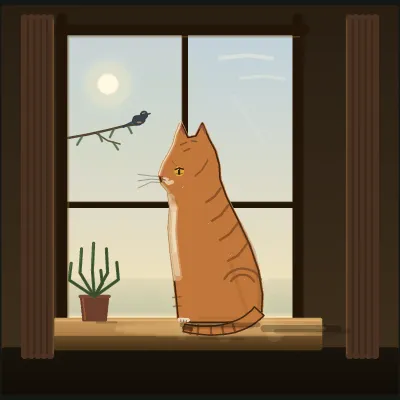
The Best Seat in the House proves the gap does not have to promise action. A ginger cat sits in a pool of morning sun, gaze locked on a bird on a branch just outside, and between them stands a pane of glass. The distance is tiny and completely uncrossable, and that single obstacle rewrites the emotion of the piece. The kingfisher's gap says something is about to happen. The cat's gap says something never will, and the drawing turns from a hunt into a daydream. This is the cheapest plot twist available to you: decide what sits in the space between your two subjects. Empty air is anticipation. Glass is longing. Try a closed door, a river, a page of homework. The characters can stay exactly where they are while the story changes underneath them.
The two things do not need eyes
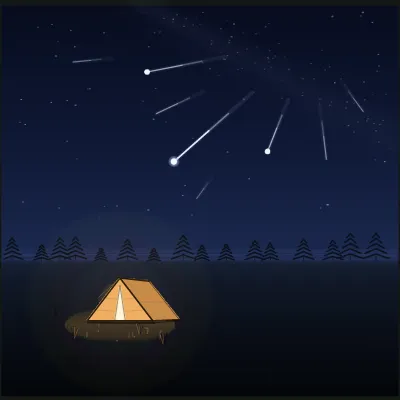
A Hundred Wishes an Hour was drawn for the Perseid meteor shower, which peaks tonight, and there is not a single visible creature in it. A tent glows from the inside on a dark meadow while meteors fall, every streak tracing back to the same point in the sky the way a real shower does. The two subjects are just lights: the cool falling stars and the one warm tent. Yet the dark stretch of night between the brightest meteor's head and the tent's peak still carries a story, because someone is obviously awake in there, and a falling star is obviously something you wish on. Once you see the gap as the subject, you stop needing characters at all. A kettle and a steaming cup, a ladder and a treehouse, a mailbox and a porch light can want each other just fine.
Steal these moves
- Give your drawing two subjects that want something from each other, and let the space between them be the story.
- Draw the moment before, never the moment of. Leave the payoff to the viewer.
- Keep the gap empty. A stray stroke in that space is furniture blocking the stage.
- Aim gazes, light, and supporting lines along the axis between the two subjects so the whole picture points at the tension.
- Change what the gap means by changing what sits in it: open air for suspense, glass for longing, distance for a wish.
Every one of these pieces is a living composition in the gallery, so you can pull the trick apart instead of taking notes. Open The Kingfisher's Dive or Any Second Now and branch it onto your own canvas: widen the gap, close it, put something new inside it, and watch the story change. Every remix keeps its lineage back to the original automatically, and if branching is new to you, the guide on how to remix digital art online walks through it step by step. And if you are outside tonight watching the Perseids, notice the gap between the streak and whatever it seems to be falling toward. That is the drawing.