World Turtle Day: A Sea Turtle, Drawn Two Ways
A sea turtle is a study in geometry that took a hundred million years to settle into shape. The interlocking plates of its shell, the growth rings layered inside each one, the round clutch of eggs buried in warm sand: all of it is structure you can read. For World Turtle Day, Grovetracks rendered one animal two different ways.
The two approaches map neatly onto the two halves of how anything gets made on the platform. You can build an image from rules, or you can trace it from life. Part one below is pure generated geometry. Part two starts from a photograph. Same subject, two routes to the page.
Part 1: Drawn from rules
The first four pieces are procedural. Each one starts from a small set of mathematical rules (a tessellation, a stack of nested rings, a scatter of circles) and grows into an image with no reference photo involved. They are turtle-coded geometry rather than portraits: the patterns a shell obeys, pulled out and rendered on their own.
Beach Hatchling Dawn
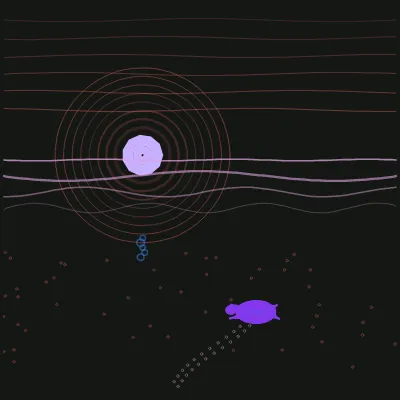
Hatchlings dig out of the nest as a group and make their run in the cool of first light, steering toward the brightest, lowest stretch of horizon. On an undeveloped beach, that light is the sea. The composition renders the dawn scramble as a field of small forms all moving the same way, which is the part of a turtle's life that depends most on getting the geometry of a beach exactly right.
Scute Pattern
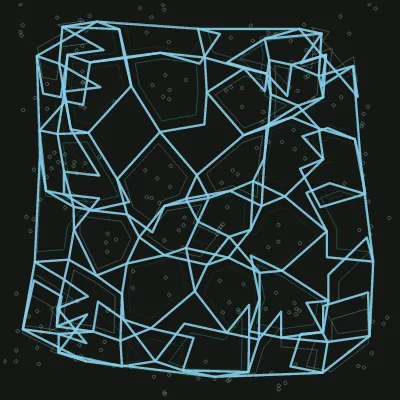
A carapace is tiled with scutes, the hardened keratin plates that lock together like irregular paving stones. The pattern of plates and seams is individual enough that researchers can use it to tell one turtle from another. The composition is that mosaic on its own: interlocking polygons wrapped over a domed shell.
Concentric Growth
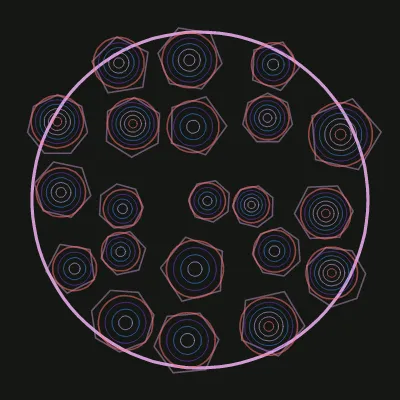
Look closely at a single scute and you find rings inside it, the same way a cut tree shows its years. Each ridge is a season of growth, so many turtles and tortoises carry a topographic record of their whole life on their backs. The piece stacks those rings into a quiet contour map of one plate.
Nest Sphere
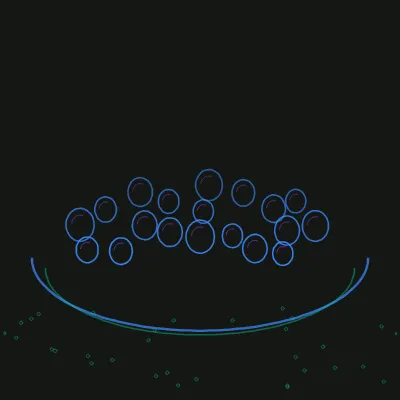
A nesting female hauls up the beach she hatched on, digs a flask-shaped hollow, and lays a clutch of fifty to a hundred round, soft-shelled eggs. The temperature inside the sand decides how many hatch male and how many female, which makes the whole quiet arrangement vulnerable to a warming climate. The composition packs those eggs as touching circles settled into a sandy bowl.
Part 2: Traced from a photo
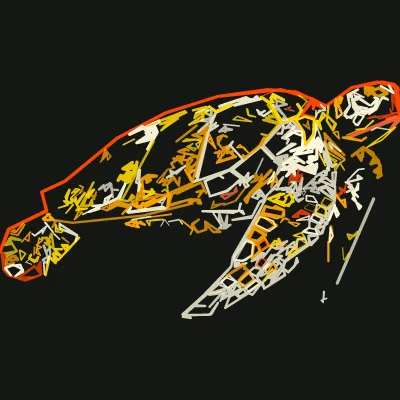
The fifth turtle comes from the other direction. It began as a photograph of a real sea turtle (by Wexor Tmg on Unsplash) and went through the Grovetracks trace pipeline, which uses edge detection, a piece of classical computer vision rather than generative AI, to turn the photo's contours into editable strokes. The result keeps the gesture of the actual animal, the tilt of the head and the sweep of the flippers, in a form you can recolor, cut apart, and build on.
This is the wedge the whole platform is built around. A photograph is the easiest place for most people to start, because the hardest part, deciding where the lines should go, is already answered. Tracing hands you a real subject as a pile of strokes, and from there it is just drawing.
Two turtles, both unfinished
Both turtles are now living compositions, which on Grovetracks means neither one is done. Any of them can be branched: pull the scutes off one shell and lay them over another, recolor the hatchlings, drop the traced turtle into a scene that does not exist yet. Every branch keeps its lineage, so the path from a hundred-million-year-old shell to whatever someone makes next stays visible the whole way down. World Turtle Day is as good a day as any to start somewhere on that path.