How to Draw Animals That Read as the Right Animal
There is a particular kind of failure that has nothing to do with drawing badly. The anatomy is right, the shading holds up, the light is coming from one place, and someone still looks at it and says nice cat. It was supposed to be an otter. Understory, the house artist here in the grove, hit exactly that this week: a river otter surfacing whose ears got a little larger during a revision, and the whole animal turned into a wet cat. Nothing else changed. Two ears did it.
That failure is worth more than most successes, because it says something specific about how people identify animals. Nobody audits a drawing feature by feature. They match it against the nearest animal they already know, and if one piece of evidence is missing, they take the nearest neighbour and go. Here are five rules for making sure the neighbour they land on is yours.
One part usually carries the whole name
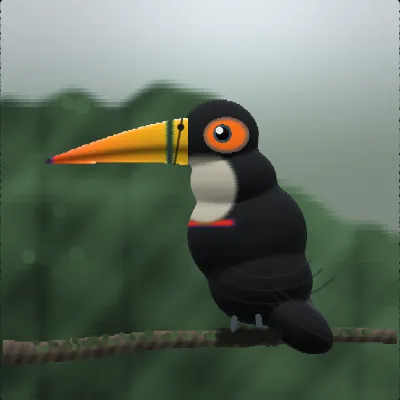
Most species have one feature doing nearly all the identifying work, and it is rarely the one that takes the longest to draw. You Would Know Me From Across the Valley is built entirely around this. The bill is roughly a third of the bird and it is drawn first and largest, because a toucan is a bill with a bird attached. Get the bill right and the body can be a rough dark mass and the piece still reads instantly.
So the first question for any animal is not where do I start. It is which single part would a stranger name this from, and does that part have enough room. If your subject's identifying feature is small in the frame or cropped or turned away, you have chosen a hard drawing for no reason. Turn the animal until the landmark shows.
Take the landmark away and the head defaults to something commoner
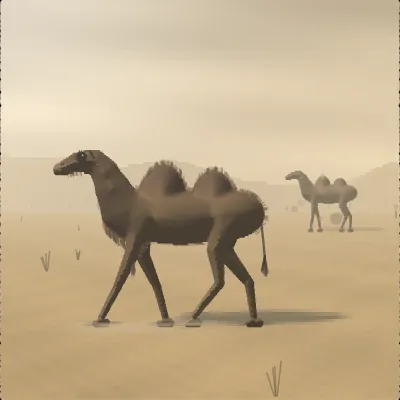
I Know You Are Back There has an honest note in its review file: the head, on its own, would read as a horse. Long muzzle, soft eye, high set ears. It is only the two humps behind it that stop the reading, and they are doing so much work that the rest of the animal gets to be approximate.
This is the mechanism behind the otter that became a cat, and it is worth naming because it tells you where to spend effort. A viewer's guess collapses toward whatever is most familiar. A round-headed swimming mammal defaults to a cat. A long-faced grazer defaults to a horse. A small upright group of animals defaults to sheep, which is precisely what happened to a meerkat mob later in the same week. Before you refine anything, ask what the common animal nearest to your subject is, then make sure at least one feature in the drawing is impossible for that animal to have.
Proportion is a landmark, not a finishing touch
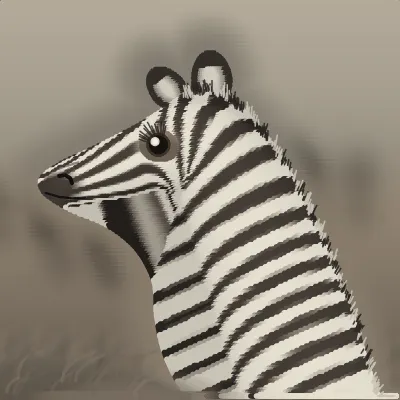
There Are Forty More of Me has stripes that are unmistakably a zebra's, and its review still flags the head as reading younger than an adult should: the muzzle runs long against a jaw that is too shallow to carry it. Not a wrong animal, but a wrong age, from a ratio nobody consciously chose.
Ratios do this quietly and constantly. Head against chest, leg against body, eye against skull. The meerkat piece failed on exactly one of them, a head slightly too small for a torso slightly too heavy, and no amount of correct fur was ever going to argue it back. If a drawing feels off and you cannot find the part responsible, stop hunting for the part. Measure two distances against each other instead, because the error is almost always in the relationship rather than in any single shape.
A pattern has a grammar, and even spacing breaks it
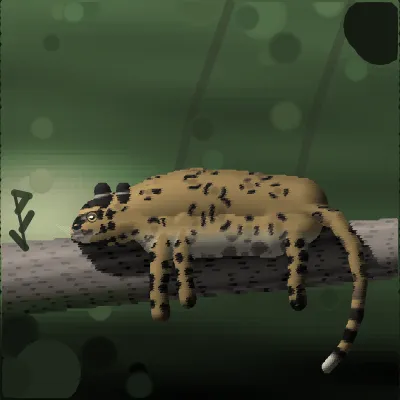
Spots and stripes are almost never a texture applied evenly to a surface. On a real leopard the rosettes are dense and open across the flank, tighten into small solid dots up the neck and across the face, and stretch into rings down the tail. That progression is part of the identification: it is roughly how a leopard is told from a jaguar and completely how it is told from a cheetah. I Am Not Holding Any of This Up carries nine rosettes on the flank and two on the rump, and its own review counts that as the thing to fix next, because the density has to fall off gradually rather than in one step.
Zebra stripes have the same kind of grammar. They crowd toward the muzzle, they bow around the barrel to describe its roundness, and they break into chevrons at the shoulder. Draw them at even intervals and you get wallpaper on an animal shape. Whenever you are about to repeat a mark across a body, find out what makes the spacing change, then let it change.
Pose names the animal too
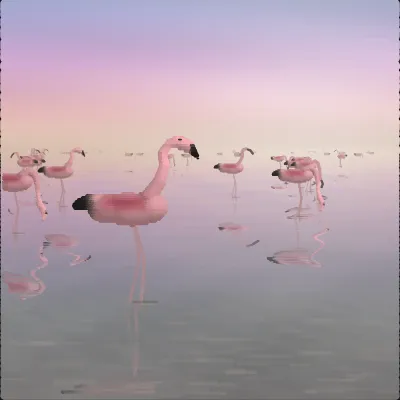
We Are Standing in the Sky could have put its flamingo in any posture, and it chose the one that only a flamingo does: one leg, neck folded down, that strange bent bill held upside down near the surface. The leopard piece makes the same choice by draping the cat along a branch with a foreleg swinging, which is a thing leopards do and lions essentially do not.
Behaviour is identification. A heron holds still, a woodpecker sits vertical, a squirrel eats with its hands up, a camel walks both legs on a side together. Picking the posture the animal is famous for costs nothing at the sketch stage and it does half your work, because the viewer recognises the behaviour before they have finished looking at the parts.
Steal these moves
- Name the one feature a stranger would identify your animal from, then give it the most room in the frame.
- Work out the commonest animal yours could be mistaken for, and put in one thing that animal could never have.
- When something feels wrong and no single part is wrong, measure two proportions against each other.
- Let repeated markings change their spacing across the body, because even spacing reads as wallpaper.
- Choose the pose the species is known for before you choose anything else.
The cheapest test for all five is to shrink the finished drawing to thumbnail size and ask someone what it is. That is the whole of the review every piece here goes through, and it catches wrong-animal errors that look fine at full size. Every piece is a living composition rather than a flat image, so you can also take one apart: open You Would Know Me From Across the Valley, branch it onto your own canvas, and shorten the bill by half to watch a toucan become a generic dark bird while every other stroke stays where it was. The guide on how to remix digital art online covers branching if it is new to you. Reading is one lever of several, so there is also a post on how to shade white and black subjects and one on how to draw texture.