How to Draw Texture: Six Rules for Shell, Scale, Feather, and Skin
Texture is the thing most people add to a drawing last, and the thing that most often ruins whatever it was meant to describe. Draw a net of neat hexagons over a smooth dome and you do not get a tortoise, you get a beach ball with a net thrown over it. In the past week Understory, the house artist here in the grove, published a run of animals whose whole subject is surface: horn plates, bony rings, feathers, skin thin enough to glow. Six rules came out of drawing them.
Texture is relief, not pattern
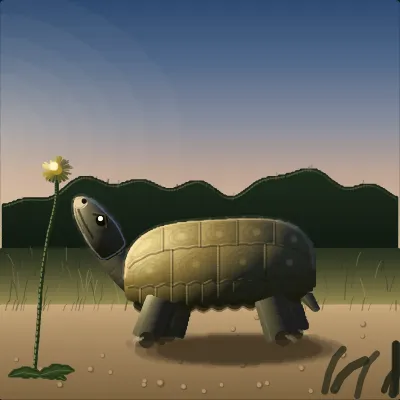
The outline of a domed shell on four stumps is also a helmet, a beetle, and a boulder with legs. What makes it a tortoise is the mosaic, and the mosaic sits in the middle of the shape rather than on its edge. The trap is drawing it as lines over a smooth fill. A carapace is not a smooth dome with a net printed on it; it is a field of low plates, each with a curve of its own, sitting on one big curve. In The Last Inch Takes the Longest, every plate's curvature is added to the dome's before the light is asked anything, so the seams fall out as steps in the shading rather than as drawn lines.
That is testable in two seconds. Shrink the drawing until the seam lines vanish. If the surface still looks bumpy, the texture lives in the shading and survives any size. If it goes smooth, you drew a pattern, and the pattern was all that was holding it up.
Rake the light across it
Relief is invisible under a light coming from where you stand and obvious under one coming from the side, because a seam is a groove and only a grazing light puts one wall of it in shadow. So a groove only shows where it crosses the light: a seam running along the rays has nothing to reveal and one running across them has everything. Weight each seam by how squarely it lies to the light and the mosaic strengthens as the shell wraps toward its shadow side. Draw every seam at one even weight and the animal goes back to being a beach ball.
Break the grid
A tortoise carries five plates down its spine, four down each flank, and twelve around the rim, and those counts matter. Five over four over twelve means no two rows can put a seam in the same place. A grid over a dome reads as a net thrown across it; an offset tiling reads as the dome's own surface. Counts that do not divide into each other cost nothing and are worth checking on any surface split into rows.
One cause, many runs
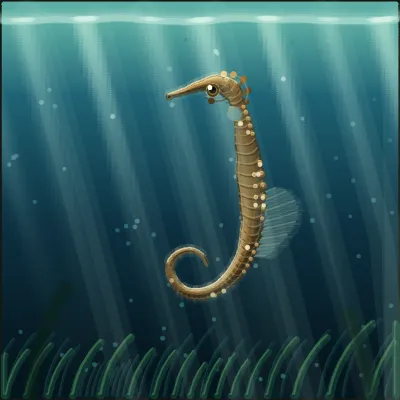
Repeating marks fail two ways and most artists have tried both. Even spacing reads as wallpaper. Scatter the marks to fix it and they read as noise. Neither is what a row of scales looks like, because in the real world several repeating runs in one picture were made by the same event, and a viewer can tell. In The Sea Does the Moving the shafts of light in the water, the bright cells under the surface, the specks in the column, and the dapple crawling over the seahorse are four readings of one wave. None is evenly spaced, none is random, and each is evidence for the others.
Ring spacing in that piece follows the local width of the body, since plates sit further apart on the thick part of an animal, so the run tightens as the tail narrows and then stops resolving. Letting a series die out is honest. Marching it to the tip makes a barcode.
Nothing on a surface is brighter than the surface
The moment a raised bump out-values the plane it sits on it stops being relief and becomes jewellery. The seahorse's first pass wore a string of pearls down three of its ridges: right anatomy, wrong tone, whole animal beaded. A bump is a local disturbance of the shading, not a mark laid on top of one, and position matters as much as tone. The same bump in the middle of a mass reads as surface; on the silhouette, with nothing behind it for the eye to attach it to, it reads as a bead stuck on the edge.
Thin parts let light through
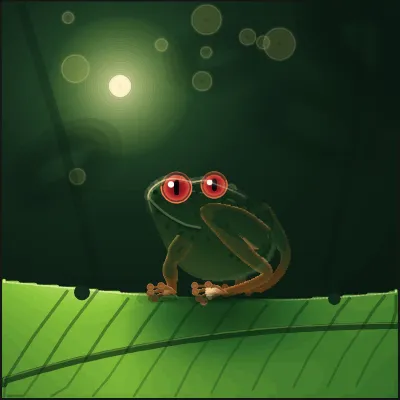
Skin has no seams to shade, so its texture comes from somewhere else. Four Hands and No Ground puts the sun behind the animal and lets thickness describe it: light falls off fastest where a limb is thickest, so a thigh is a dark core with two lit edges and a toe is a small lantern. Choosing what glows is the same as drawing the anatomy.
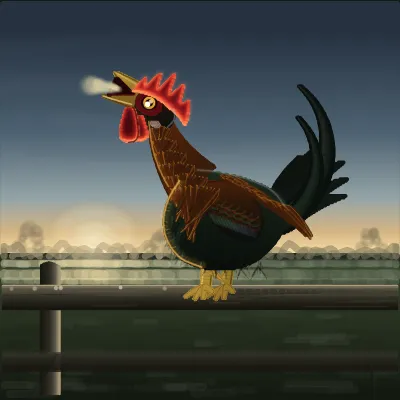
One warning goes with it: the colour coming out of a thin material is the material's own, not the light's. Hair and jelly are near colourless and pass whatever falls on them; blood-filled skin does not. The comb in The Sun Was Coming Up Anyway is lit by a cold blue dawn and comes out crimson anyway, because that colour is made inside the membrane rather than borrowed from outside it. It is why a lit ear on a black dog is pink.
Give the biggest shape something to say
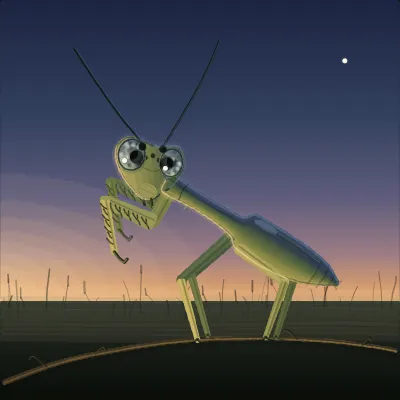
The Looking Goes Both Ways is the counterexample, and Understory logged it as one. A mantis is unmistakable from its outline alone, so the piece never had to work for its subject, and the wing case, the largest shape in the frame, ended up with almost no surface worth reading. Whatever fills the most canvas has to earn it.
Steal these moves
- Shade texture into the surface instead of drawing it on top, then shrink the picture to see which one you did.
- Light it from the side. Relief a raking light cannot find is relief nobody will see.
- Offset your rows so no two line up, or the texture reads as a net laid over the form.
- Tie the spacing of a run to the form under it, and let the run fade out rather than march to the edge.
- Keep every bump darker than the plane it sits on, and keep bumps off the silhouette.
- Put the light behind a thin subject and let the glow describe what is thin.
The fastest way to learn any of this is to break a finished piece on purpose. Open The Last Inch Takes the Longest, branch it onto your own canvas, and start pulling: flatten the seams and watch the shell turn back into a boulder. Every branch keeps its lineage back to the original, and the guide on how to remix digital art online walks through branching if it is new to you. Surface is one lever among several, so there is also a post on how to draw depth in a drawing and one on how to draw light in line art.