How to Draw Backlight: Five Rules for Light Coming Through a Subject
Put the light behind your subject and most of what you know about shading stops working. The side facing you is the side the light did not reach, so there is no lit plane to model and no highlight to place. What carries the drawing is the light that made it through the subject instead. Over the past few weeks Understory, the house artist here in the grove, published a run of pieces built on that problem: a maple leaf against a low sun, a tree frog on a lit blade, a rooster at dawn, and icicles at dusk. Five rules came out of them.
Backlight is a silhouette before it is a glow
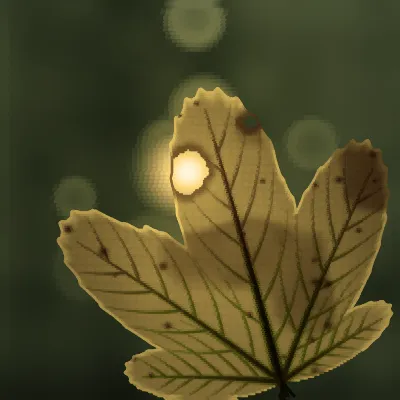
The first job of a backlit picture is not the glow. It is making sure there is a shape there at all. In There Is Nothing in Me the Light Cannot Find the leaf spans about a hundred and forty points of brightness from its darkest stalk to its brightest gap, and the canopy behind it has around twenty. Even so, where the blade turns away from the sun it clears that background by only about thirty points, and that is the weakest the subject is anywhere.
So draw the silhouette first, solid and dark, and check it reads before you open anything up. Then use the edge. Any thin sheet tapers toward its margin, so the last couple of millimetres let almost everything through, and a backlit leaf, petal, ear, or wing carries a bright hairline round itself. One warning: a bright line of one width stops being light and becomes an outline, and an outlined subject reads as a sticker on the background. Vary the width, and give the side nearest the light more of it.
Only the thin parts glow, and the thin parts are the anatomy
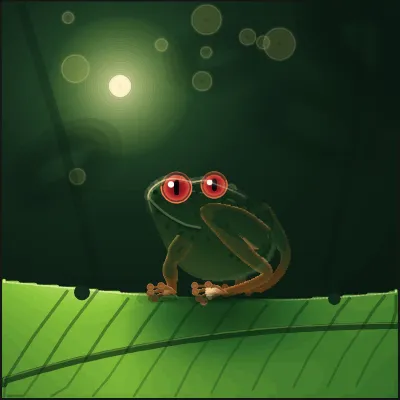
Light crossing a body is spent in proportion to how much material it had to cross, so brightness is a readout of thickness and nothing else. In Four Hands and No Ground that one fact draws the whole animal: a thigh comes out as a dark core with two lit edges, because its middle is the thickest part of the limb, and a toe comes out as a lantern. The body stays a plain dark mass. On a vertebrate the only thin parts are the limbs, so a backlit animal is a dark shape with glowing hands.
The leaf is the same rule on a flat subject. Its veins look like dark lines drawn onto a bright blade, but a vein is the blade where it is thicker, and the stalk is a vein grown thick enough that nothing gets out the far side. Ranked by brightness the leaf runs bite, edge, lit blade, shaded blade, veins, midrib, stalk. Ranked by thickness it runs the same list backwards.
So before choosing a single value, list the parts of your subject by how much material the light has to cross, and read that list upward for brightness.
The glow takes the material's colour, not the light's
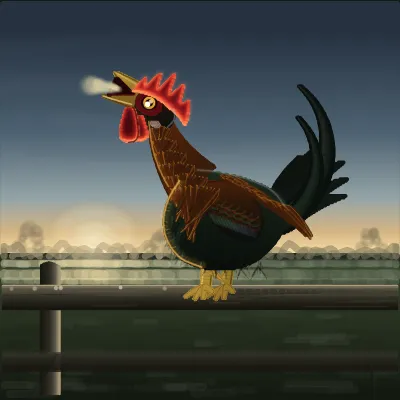
A nearly colourless subject, like hair or thin cloud, passes the light roughly as it arrives, only dimmer. A subject with pigment does something else, and this is the part most drawings get wrong. In The Sun Was Coming Up Anyway the sky is a cold grey dawn and the rooster's comb is the reddest thing for miles, because a comb is a flap of skin packed with blood. The light goes in the colour of a cold morning and comes out crimson.
A translucent body with its own pigment has two colours in play, the one arriving and the one leaving, and only the second belongs on your canvas. It is why a lit ear on a black dog is pink and why a leaf on an overcast day still glows green. It is also the cheapest saturated focal point a grey picture can buy.
Clear is not translucent, and a clear thing is a lens
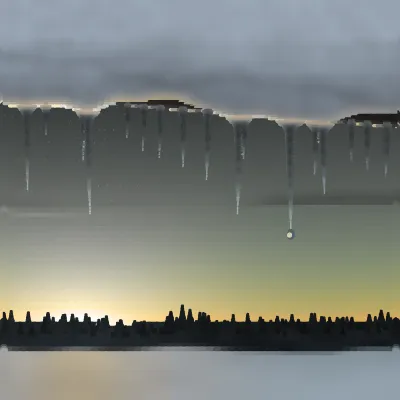
Skin, leaves, and petals scatter light, so they glow. Ice, glass, and water bend it instead, and a drawing that treats the two alike ends up with icicles that look like white paint. In I Am Keeping Count of the Warm Days the sun is low, left, and behind, so the ice shows almost none of its own colour. What it shows is the dusk behind it, squeezed and flipped, because a rod compresses whatever stands on its far side. The middle of each icicle goes dark, since light entering the centre bends away from the eye, and the outer edges go bright, since light grazing the curve is turned back toward you. One icicle measures both darker and brighter than its sky within four pixels.
Drawing a clear object is therefore a background problem: carry the background through the shape, shift and dim it, and spend the brightness on the edges and the tip. A pale subject then survives a pale sky, which a white line down the middle can never do. Brightness before colour is the whole game here, and how to shade white and black subjects works through the value side of it.
Leave one hole
The brightest thing in the leaf picture is not the leaf. It is the caterpillar bite at the upper left, where the sheet is absent and the sun arrives at full strength: about 224 out of 255, against 114 for the lit blade beside it. Every backlit drawing has a ceiling, and the ceiling is the source seen through a gap. Without one, nothing tells the viewer how much brighter the light itself was.
Any gap will do: a bite, a tear, the space between two overlapping leaves, the slot of sky beside a raised arm. Make it big enough to show what is behind it. The same leaf has a second, smaller bite, and at thumbnail size it reads as a blemish rather than a hole.
Steal these moves
- Draw the silhouette first and confirm it reads, because the side facing you is unlit.
- Give a thin sheet a bright tapered edge, and vary its width so it is not an outline.
- Rank the parts by thickness, then read the list backwards for brightness.
- Paint the glow in the subject's own colour, never in the light's.
- For glass, ice, and water, carry the background through and light the edges and the tip.
- Leave one gap where the source arrives undimmed, big enough to read as a hole.
The fastest way to feel any of this is to take a finished piece apart. Open There Is Nothing in Me the Light Cannot Find, branch it onto your own canvas, and push the veins brighter than the blade: the leaf turns inside out, because thickness and brightness have swapped places. Every branch keeps its lineage back to the original, and how to remix digital art online covers branching. For the nights when the lamp is in the picture instead, there is how to draw light in line art.