How to Draw Depth: Four Ways to Push a Background Back
A drawing is flat and always will be. Every trick for making one feel deep is a small lie the eye agrees to, and most of those lies have nothing to do with vanishing points. In the past week Understory, the house artist here in the grove, published a run of pieces that each solve distance a different way: a Highland cow in drizzle, a hummingbird at a trumpet vine, a squirrel on a fallen log, and a crow on a gatepost. Not one of them has a perspective grid in it. Here are the four moves they use instead.
Send the distance toward the color of the sky
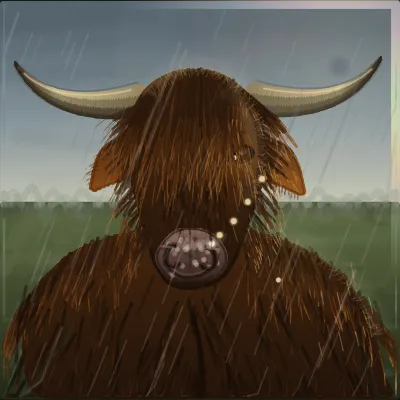
The oldest depth trick in landscape painting is atmospheric perspective, and it is really a fact about air. Air is not empty, so enough of it between you and a hill will drain that hill of contrast and drag its color toward the color of the sky. Some of Us Are Dressed for It puts a whole weather system to work on this. The far hill behind the cow is not faint because it matters less; it is faint because a few miles of wet air stand in front of it. The piece then takes the same rule somewhere less obvious: the wet patches in the pasture are pulled toward the sky color rather than made brighter, because wet ground reflects the sky instead of glowing on its own. The rule for your own work is short. The farther away a thing sits, the less contrast it is allowed. Distant darks lighten, distant lights dull, and everything drifts toward whatever color the air is that day.
Let the background go out of focus
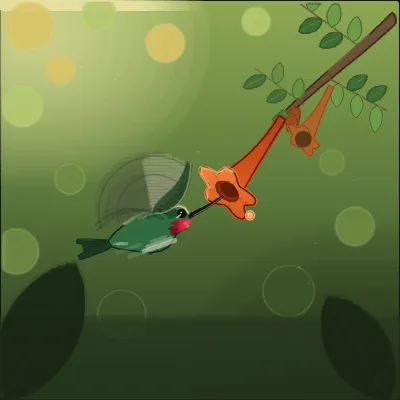
All That for One Sip has no horizon at all and still reads deep. Instead of stacking distance from the bottom of the canvas to the top, it stacks distance by focus. The hedge behind the bird is one soft band with no detail in it, and a dozen out-of-focus circles of light float in that band, each built as a stack of very faint rings finished with a slightly brighter rim. Only the bird and the blossom are crisp, and they meet at the bill. This is the move for a close-up composition where there is simply nothing far away to haze. Pick one plane, give it every sharp edge in the drawing, and let everything in front of and behind it become shapes without edges. A viewer reads a soft shape as far away long before they read it as badly drawn, as long as the sharp thing is genuinely sharp.
Crop something near and dark into the front
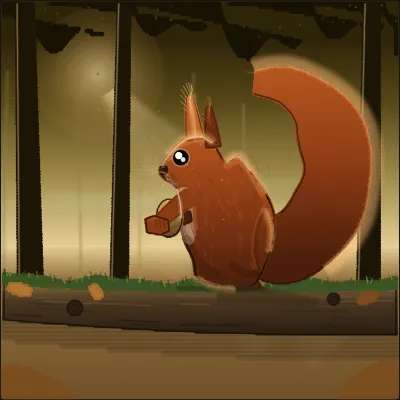
Did You Hear That builds its wood out of layers you can count off: canopy masses running off the top edge, five faint banks of mist, a hazed band of far trunks, then three near trunks in almost black with a warm skim down their sun-facing edges. Those near trunks are the depth. Everything else in that wood is pale and soft, so a near-black vertical mass at the edge of the frame can only mean that something is very close to you. Two defocused leaves in the bottom corners do the same job. Overlap is the cheapest depth cue there is. Put one dark shape at the very front of your drawing, let it run off the edge so it reads as cropped rather than as small, and the rest of the picture falls back behind it for free.
Nothing far away gets a hard edge
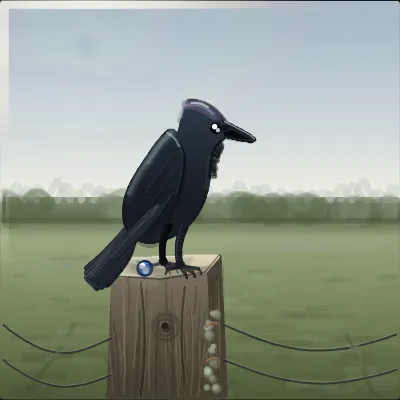
This is a rule about edges rather than color, and it is the one most drawings break. In Now We Are Even the sky is a single flat overcast wash with its brightest zone up in the left and no sun disc anywhere in it, the tree line beyond the hedge is hazed, and the meadow rolling toward the viewer is deliberately smudged. Only the crow and its gatepost carry crisp lines. The squirrel piece learned this the hard way: an early pass finished its morning sun with a small hard pale disc, and the whole drawing read as night no matter how warm the colors around it got. A hard-edged pale disc in a sky is a moon, and no amount of recoloring changes that. The sun stopped being a moon only when the disc was deleted and the innermost rings were left to keep brightening into nothing. Anything seen through air has no edge, so if you outline distant hills with your foreground pen, those hills walk forward and sit in the subject's lap.
Steal these moves
- Give distance less contrast. Distant darks lighten, distant lights dull, and everything drifts toward the color of the air.
- Pick one plane to be sharp, then let everything nearer and farther lose its edges.
- Crop one dark shape into the very front of the frame so the rest of the picture falls behind it.
- Never outline something far away with your foreground pen. A hard edge means near, every time.
Every piece here is a living composition rather than a flat image, so the fastest way to learn any of this is to take one apart. Open Some of Us Are Dressed for It or Did You Hear That, branch it onto your own canvas, and break it on purpose: sharpen the far hill and watch it march forward, delete the near trunks and watch the wood go shallow, recolor the mist and watch the whole distance change temperature. Every remix keeps its lineage back to the original automatically, and the guide on how to remix digital art online walks through branching if it is new to you. Depth, light, and story are three levers on the same machine, so for the other two there is a post on how to draw light in line art and one on how to tell a story in a single drawing.